Tuesday, June 9, 2020

6/9: An Open Letter to Our Elected Officials


The following is a short letter I wrote and am dispersing to every elected official who represents me, with slight modifications based on what is up for debate/vote in their body. If you're inclined to do the same, this tool is an excellent resource to look up who represents you from the county up, as well as how to contact their offices. Make them work for a living.

Hello,

My name is Sam Rapine. I am a twenty-seven-year-old medical professional, splitting my time between the emergency department and intensive care unit in a Montgomery County hospital and the streets as a firefighter/EMT while pursuing my certification as a registered nurse.

I am also white, and that I need to specify this lies at the heart of why I’m writing you today.

In point of fact, I never written my representative. Not in the House or Senate at any level, nor an ombudsman, nor even so much as my college’s provost. I have never felt the need, as my life is lush with opportunity. I currently hold a bachelor’s degree in political science, and I am lucky enough to have tried my hand in that field, found it lacking in fulfillment, and been able to return to school with support and approval on every level. With twelve- and twenty-four hour shifts, I fit in my runs at odd times. Flush with exhaustion after some of those shifts, I may not always drive with the diligence that I should.

The recent events in Minneapolis and Louisville, as well those in Ferguson, New York City, and indeed every American city, illustrate that my reality is stunningly, unconscionably distant from that of black Americans. Every black American is entered into a lottery every time they go for a jog, or start their car, or even when they lay down to sleep in their own home. The headlines remind us that these activities, ones which you and I undertake so freely, are rolls of the dice for non-white citizens of this country, and the losing roll means a knee to the back of the neck, a crushed windpipe, or eight bullets into a prone and defenseless body.

Many of my neighbors live in a failed state. Extrajudicial killings, de facto apartheids, and systemic disenfranchisement are the stuff of autocracies. And while my writing this letter without fear of recrimination means that we are not all the way there, that such entreaties are no doubt papering your desk means that we are bound in a dangerous direction.

I’m imploring you to help stop this, and damn the cost. Politics is often—of valid democratic necessity—a game. In contrast to the bloodshed and Hobbesian sovereignty that came before it, there is beauty in that dance of give and take, an understanding that in compromise and capitulation we can reach a middle ground on which we can all comfortably stand.

Today we are not fighting for middle ground. Today we waver at the crumbling edge of a cliff.

Forget political capital, forget election strategy, and forget party divisions. If we fail to address this problem, there is no reason to raise the flag in the morning because the republic for which it stands will be a lie. If we cannot agree that we as a country are in desperate need of massive, lasting change, then Washington’s Great Experiment will have but one undeniable outcome: failure. And most importantly: if we do not act now, the blood of innocent men, women and children will be on our hands.

There are things, some specific, some broad and ready for interpretation, that you can do in your position:

  • ·         The Justice in Policing Act of 2020 is the tip of the spear in effecting meaningful change. I want you to throw your full weight behind it, and urge your fellow Representatives to do the same.
  • ·         Demand thorough reevaluation of use-of-force policies in every department, coupled with a physical fitness and martial capability requirement. Numerous combat systems teach techniques to incapacitate and neutralize threats, and these should be drilled ad nauseum to diminish the need for lethal force to resolve a situation. It will take patience, persistence, and sweat to reach this level of proficiency on a mass scale, and if that’s the price to pay to save American lives, every police officer worthy of the title should be glad to pay it.
  • ·         Police unions have grown entirely too powerful, and this has led to a complete lack of accountability. I support unions as a rule. However, when a union’s financial might has made challenge impossible in the court of law, it is a clear sign that their original intention of fair representation has accomplished the exact opposite. Their unchecked power needs correction.
  • ·         There is no reasonable argument against body cameras, nor in favor of their discretionary use. Body cameras protect our citizens from improper policing every bit as much as they protect good police officers from unfounded allegations. Footage conveys fact with unparalleled clarity, invariably to the benefit of the rightly-acting party or parties.
  • ·         Mayor Melvin Carter of St. Paul raised the inspiring notion of community-based policing—that the best police officers would be "people who understand and know our community, who see the beauty of our community, who feel comfortable and safe in our community." This sentiment cannot be echoed loudly enough, nor often enough. An emphasis on the importance of police officers from the community that they are sworn to protect is critical in reshaping our notion of policing away from “battlespaces” and toward peacekeeping.
  • ·         Please take seriously notions of “defunding the police”. It isn’t the slogan I would have chosen, but all the same: this is not a rallying cry for anarchy, nor is it a utopian ideal. Think of it instead as an acknowledgment that the police are asked to address a dizzying breadth of issues for which they are not trained, equipped, or inclined. Relegating issues of mental health, homelessness, and even non-violent crime of systemic origin like drug use and custody issues to the right hands diminish strain on the police while giving people the help that they need—and the faith in the system that they deserve. Funding alternative programs takes the onus off of the police, who are clearly taxed beyond their limits.


This is by no means an exhaustive list, and if I may make one final recommendation, it is to heed groups like Campaign Zero, Reform Alliance, the Sentencing Project, the Innocence Project, and many similar organizations. With dedicated members, tireless work, and unshakeable vision, they need the same from you to clear the way and bring about real change.

As I mentioned at the beginning of this letter, I am an emergency medical technician. As I registered at a state and national level, I know that I went through the same lessons that Breonna Taylor did. She and I learned the same techniques to splint an arm, the same grip on a bag-valve mask to give oxygenated breaths, the same rate of compressions to provide lifesaving care. Years and miles apart, we both climbed aboard an ambulance for the first time, and we both came to believe in the number that America calls when it needs help: 911.

Breonna Taylor was shot dead in her home by the people on the other end of that number. They betrayed her trust. They betray black Americans every day, and I need you to help me put an end to it.

Respectfully,
~Samuel O Rapine
PA EMT-B #215204

Monday, May 25, 2020

5/25: Things Get Excessive

I went a little Xanadu on the garden today.

No, I didn't pine after my childhood sled on my deathbed (eighty year old spoiler alert?). Nor did I compose eleven minutes of ascendant rock glory. No, I refer to the Xanadu of lore, that arboreal paradise of the Khans, said to embody perfection beyond time.

I mean, what I actually did was build a trellis. But it's a lot of fun to yell "XANADU!" while you do it. The neighbors disagree, but this isn't a blog about my neighbors.

Anyway: all none of my faithful readers may recall this little beauty, living at the foot of my garden:


What's harder to make out, buried amidst the verdant chaos, is that the plant as a whole is really just a bundle of vines, given shape by a now-subsumed wooden trellis. This plant, the mandavilla, will travel along lattices or wires, shooting off lovely red flowers as it goes. And while I'm sure it could thrive just fine spilling out into the lower sixth of the garden, why pass up the excuse for a woodworking project?


The idea was for an arch, relatively freestanding, tapered in emulation of a Shinto gate, to stand over the plant. I'd then track down some wire and string it in a more or less haphazard web in the air in between, and over the season (if I don't kill the damn thing) the mandavilla would wind its way up to the top, resulting in a beautiful overgrowth along the entire structure.

I had most of the wood on hand, but for the sake of aesthetic I snagged a pair of eight foot studs and kept their length intact, opting to sink 1-2 feet into the ground to either side of the plant. Determining the width of the arch was easy; I had a piece of 2x8 that I cut into half, coming to a hair over 3'. I made the first cut at random and copied the angle on the other side, and the other half of the cut board so I had two of these:


Then I took the longest length of the resultant trapezoid and cut one more board to match it for a lintel overtop. A coat of Jacobean stain and a few drywall screws later and we had ourselves an arch:


And then I raised it like a one-man Amish village:


(Also, I totally forgot that, I don't know, supports were a thing. So, hoping it wouldn't topple over and rip the mandavilla from the ground like an earthen catapult, I ran back in and cut the two posts seen bolting it in at the base.)

I debated the filament for a little while. I have plenty of 5-strang paracord on hand, which I could gut for the filler and do the job. But it's relatively fragile, an ugly white, and a waste of paracord besides. Twine, too, seemed flimsy; although I wouldn't mind the earthy aesthetic I'm not terribly convinced that it would outlast the plant.

Then I remembered a few off-cast pieces of chicken wire that have been hanging around the grill since last year, and I realized one of those truths that's only obvious when you aren't thinking too hard about it: chicken wire fencing is just made of wire! (to the best of my knowledge, there are no chickens involved in the process. That comes after.)

I sat down with a lap full of this stuff:


And for twenty minutes as I chafed my thumbs and strained my eyes, I experienced a singular transmutation into another reality: the Sam of another universe, who, having come into hard times as a private prison warden, picks up a side hustle slinging artisan, hand-crafted barbed wire on Etsy. But the results were worth it: several feet of perfectly usable metal wire, almost invisible in dynamic light, easily stapled in and durable enough to outlast the season at least.

Judas Priest meets Charlotte's Web.
Now we wait. There were an encouraging amount of vines already streaming off of the main bulk, like cellulose fireworks frozen in summer time, and I gently routed them up the strands and toward the sky. With any luck, August will see seven feet of streaming red flowers one or two curious hummingbirds, and one happy amateur gardener.

If not, I can always turn it into a pullup bar. Though I'll probably add a few more supports for that one.

Listening to: Dead Boy's Poem-Nightwish
Reading: House of Chains by Steven Erikson
Drinking: Jovial (dubbel) by Troegs

Friday, May 22, 2020

5/22: First Rain

I met a patient yesterday, which is itself a rarity. In the ICU, if patients are this side of consciousness, it's safely in the grip of a bleary cloud of sedatives. Nobody wants to be cognitively present with a tube tickling their lobes. In our unit, the notable exception is the open-heart surgery patient. Having recently been gutted like a trout, (s)he takes a few days to convalesce under the watchful eye of a cardiothoracic nurse, a singularly talented medical professional who rides the fine line of whipping their patient back into shape while making sure an errant sneeze doesn't give them a fleshy new hole for an arc reactor.

These patients spend their stay moving between the chair and the bed, learning how to move safely, eating enough to satisfy the nurse, and generally being bored out of their skull until they're well enough to head home.

I met one such patient on my shift yesterday and, perhaps sensing that I am in fact a fellow old man masquerading as a sore young man, we broached the subject of our gardens. He told me about the cucuzzi squash, an enormous green variety known to be vibrant, enormous, and delicious, that he's only ever found at Genuardi's Gardens in Norristown.

Well, he ought to collect a cut. Needing a few more spices, I swung by today and picked up some parsley and basil plants. And there, in the corner of a spectacular selection, sat an unassuming tray of modest, round-leafed plants, "Cucuzzi" scrawled on the cardboard sign in front. I snagged one and headed to the register.

The cashier took one look at my selection, then eyed me. "You know what you've got there?"

"I had a patient yesterday who said you guys carry a squash that'll grow the size of my leg."

This tickled her.

She gave me a few pieces of advice regarding placement and support, and sent me on my way with visions of yard-spanning arbors that I will dutifully suppress until I own property.

I did have a spot in mind, though.


I assume this used to be part of a clothesline setup, but as long as we've lived here, it's just been a crooked metal pole at the edge of the yard. In my mind, I sketched a few screwed collars supporting horizontal boards, and set to work at the base.


Some termite-bitten old moulding from the woodpile, some dubious cuts with the backsaw, and some hasty buttings with drywall screws, and we had this:


Add one nascent Freudian supersquash...


And we've got ourselves an experiment!


This should give us partial sun--the bushes will likely eclipse the hottest of it in the afternoon. Whether this is advisable, I don't rightly know. But that's why it's an experiment and not...you know. A good idea.

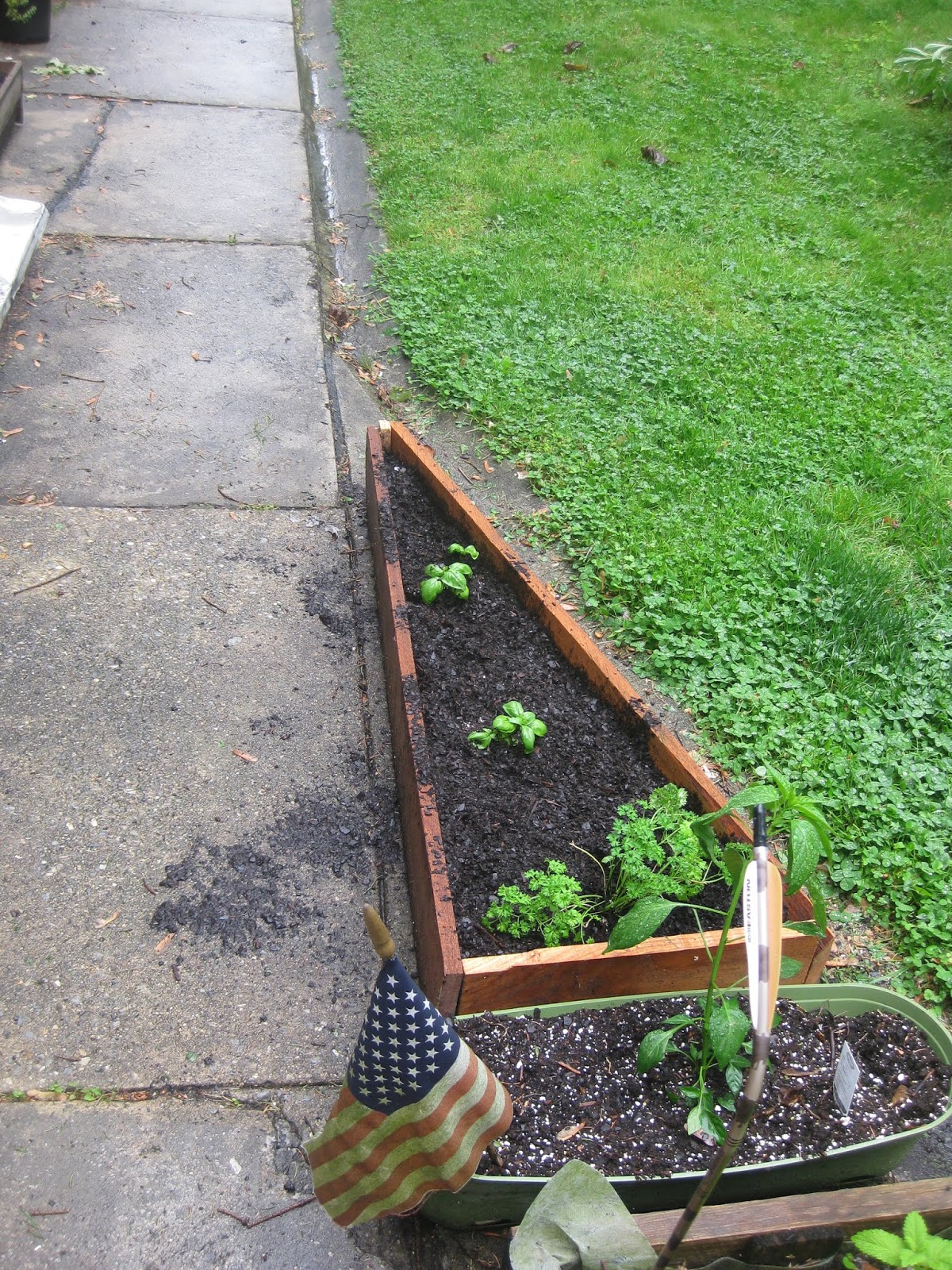
I also got my Tetris on and threw in another small herb box, in the big triangular space where I clearly should have extended the last one:


Two basil plants, plus what I thought was cilantro but turned out to be parsley. As I said--strictly an amateur operation we've got here.

Before, and during, all of this, we had our first vigorous rain since planting. I summoned it, of course, by watering the whole thing this morning, which has proven to be more effective than three rain dances, a porcine sacrifice to Demeter, and scheduling an outdoor wedding in April.

It was reassuring, just as it was last year. Everything looks supple, vibrant, vigorous, like it crossed some threshold between these plants that I stuck into the ground to genuine parts of the soil. Everything's drunk deep, ready to strive toward the sun, and I can sit back and...oh, who am I kidding? That rosemary's growing crooked. More puttering in my future for sure.

Listening to: The Cat Among the Pigeons-Roaring Jack
Reading: A Soldier in the Great War by Mark Helprin

Monday, May 18, 2020

5/18: On Becoming an Old Italian Man

I feel like I understand little old Italian men a little better when spring comes around.

Not literally, mind you. My command of the Italian language spans from the verbal butchery of the entree menu at Magiano's all the way to emphatically gesturing "MARGHARHETTI!" a la Eli Roth from Inglourious Basterds. No, my perception of kinship rests on that hypnotic, zen-like infatuation with the garden.

(Yep, it's another garden post. C'mon, it was either that or beer.)

It's hard to explain the urge to simply be in the garden once it's planted. Certainly you're not going to see change as it happens; it's a very close cousin to watching the grass grow. And there's only so much work to be done if you've planned right; straighten a stake here, pluck a few weeds there, but ideally, foresight and lessons learned have done the heavy lifting thus far.

For a while I found excuses to putter, kneeling in to look closer at leaves and stalks, until I stopped to ask--why?

It's hubris to think that the miracle of a garden rests in the hands of the gardener, but their role is nevertheless a crucial one..We build boxes, haul soil, and pluck weeds in service of a minute cradle of life, running interference against insatiable entropy so that infantile stalks and leaves can strive toward the sun. We put dozens of species of weed and vermin to the proverbial torch for the sake of the one we wish to see rise, and if we do it right we can put food on the table--which is as simple a concept as it is powerful, considering that in 2020 a potato has a pretty good shot of traveling further in its lifetime than the person eating it.

By its existence alone, there are already so many primal forces at play in my ninety-four square feet of garden--those of construction, creation, conscious production and consumption, and even the interplay of life, both for my sake and its own. Why do I feel this impulse to add to it without cessation? I alone, among all the beasts that were born and bred, seized a patch of land, with its grass and soil and worms, and changed it, shaped it against the streams of inertia and Darwinian circumstance to grow this and not that, and grow it to fullness and fruition. Why, when I've stepped out of the natural cycle to spin a tiny one of my own, can I not step out of it?

This all wheeled through my head as I straightened up, my knee digging a crater into the topsoil next to the squash. I went inside, picked up an old favorite book, and went back out with a cup of tea in hand to sit next to the garden. I put up my feet, opened it to the bookmark, and enjoyed the breeze as it rustled through the lily at the end of the lowest box.

Gorlami.

Earlier today:

I threw up a pair of frames for the spaghetti squash. Due to space constraints I made them pretty vertical, knowing that sometime in mid-late July I'd have to cut out some cloth holders for what I hope will be several pound squashes. A few pallet boards and some leftover chicken wire...


...and we have a solid addition. The one pictured is completely vertical; the one about two feet off camera to the left is at a 75 degree pitch. Tomorrow I hope to add one for the heirloom and one for the Japanese egg plant in the lower bed.

And we have first growth! Three of the four potatoes I planted have woken up, and I have hopes for the fourth. Once they reach a foot I'll add the next layer and see how well this idea works.


And, though I was probably still working on solid food when this was planted, I do love the week or so when I walk out to see this every morning:


Listening to: Down and Out in New York City by James Brown
Reading; A Soldier in the Great War by Mark Helprin

Thursday, May 14, 2020

5/14: In My Atomic Garden

Sorry, this is a post about an actual garden, not Bad Religion.

If you're living anywhere near me right now, you probably woke up into a Disney movie this morning. Not the modern Disney, mind you--no pirates, no Darth Vader, no Captain America. This would be the Disney of your grandparents, in which bluejays did laundry and princesses sang through open windows to emphasize just how unreasonably gorgeous it is outside. Indeed, as I sauntered through the doorway this morning, coffee cup in hand, I whistled my joviality at a passing bluejay, hoping at the very least that it might ball a pair of socks for me. Instead it opted to crap on my car. I suppose I deserved that.

Undeterred, I set out into the world, equipped only with the vaguest idea regarding the shape of my garden, a cloth mask, and a firmly intact terror of other living beings. Not because of fear of the coronavirus, mind you--if I haven't picked that up in the ICU full of critically ill coronavirus patients, I'm not worried about transmission through two masks from a Home Depot greeter--but because when other people get twitchy about their safety, I start to worry a bit about my own.

Maybe this is seguing toward Bad Religion territory.

Not pictured: the desiccated sacrifice to Nurgle, Chaos god of pestilence, by the assembled mob.

Anyway, plants. I had a few goals in mind for the garden this summer:

  • Salsa. Many moons ago, on a lovely day with weather not unlike that which we drink in right now, my dear mother declared that she was going to go into her own garden and come back with salsa. As I searched dumbstruck for the Tostitos tree, she plucked a few succulent tomatoes, diced them up with an onion, some garlic, and cilantro, mixed it all together, and presented it with a bowl of freshly baked tortilla chips. I thought it might be cool to be able to do that.
  • Hot sauce: In a similar vein, I thought it would be a handy combination of my enjoyment of self-sufficiency, creation, preservation, and schadenfreude to be able to make a hot sauce out of ingredients I can grow myself. My first thought was that the vinegar may be difficult to source; my next thought was that I need only get lazy when I cork the last bottle of my next batch of wine.
  • Function: Generally speaking, I'd like to be able to wander into my garden, spot a ready vegetable, pluck it off the vine, and have dinner. While obviously a mouthful of jalapenos probably won't suffice, for that reason I worked in squash, eggplant, and what may prove to be a colossal amount of potatoes. More on that last part in a minute.
  • Survivability: Let's not get ahead, here. I've pulled off this whole "garden' thing exactly once, and while 100% is a nice figure, N = 1 diminishes it substantially. I suppose I still lack the stones to do this from the seed, which is why everything I put in the ground today already has leaves on it. But hey, full stomach > green thumb cred every time.
So, the garden. If you want to see the shell of it, check it out here. I have three beds, terraced, about 3' by 6', 7', and 9', top to bottom. The top has the frame of a cage that didn't see enough chicken wire, so now it's the laziest arbor in Montgomery County. In irrational shoot of kale made it through the winter and is thriving in the top bed, which I let lay as a sacrifice to the god of rabbits.


I'm pleased to announce that as of 1 p.m. today, the garden itself arrived in the prepared shell, in a flourish of split mulch bags, dogged scrabbling in the dirt, and a gentle soak with the hose to settle everything in. Behold!


Last year, I took a shotgun approach and let the tomatoes run free, turning the center planter into what I've dubbed Tomato Borneo. To my surprise they all thrived, and with only the flimsiest latticework to hold them, they soon exploded outward, linking up into a verdant rampart. If you could penetrate the outer thicket of vine, you'd be rewarded with the lush scent of about ten thousand Sun Sugar cherry tomatoes, free for the plucking, plus a few cucumbers laid across the ground for good measure.


Traditionally the bottom bed has been chock full of flowers, but flowers don't taste great and their nutritional value is nil as I am not a ruminant. My concession, however, was that vigorous looking lily you see at the very foot of the whole garden. There's a wooden lattice in the midst of that leafy embrace, and according to the tag the lily is only at a third of its full height, so I look forward to figuring out a clever way to support that as it grows.

Ah, and the potato box.

Zdravo, podrug.


Doesn't "potato box" just land? Grapes, grapes are regal. Distinguished. Grapes get a trellis. Tomatoes, those lofty drops of heaven, they get towers. Potatoes? You put potatoes in a box. They are peasant food, and I mean that as an honor because I start most days with half of one.

The principle is brilliant: a small box of dirt, with room to expand. Plant the potatoes, wait until they break the surface, add more box, bury the plant again. It breaks the surface again, you bury it again. Rinse, lather, repeat, until you have four vertical feet of ground, chock full of potatoes. Unscrew the box panels as needed. I've heard of people breaking 100 lbs of potatoes on four square feet of patch just by building skyward, and I'm very interested to see if I could pull off something similar.

So to recap: a (relatively restrained) crop of tomatoes, peppers, squash, eggplants, and potatoes, plus one majestic-ass lily that alleges it can turn into a tree. We'll have to see what else I come across as spring progresses.

Y'know. Assuming the famished mobs don't rip me to shreds.

Listening to: (surprisingly not Bad Religion!) Martin Miller Session Band-Kashmir
(Re)reading: House of Chains by Steven Erikson (Malazan Book of the Fallen book IV)
Drinking: Workhorse Baltic Porter (Oh my god)

Sunday, May 3, 2020

5/3: Making the Cut

Like many men, I have a nebulous relationship with the hair that grows between my eyebrows and my chest. The tale begins in the eighth grade, where--in addition to a locker filled to bursting, the faint odor of onions, and exactly nothing else--the fact that I shaved set me apart from the rest of the class; it was remarked upon and commented about for ninety awestruck minutes and then promptly, blessedly, forgotten.

The milestones came and went: conquering the neckbeard, first bloodless shave, discovery and implementation of the trimmer. The fads and trends ensued as well: of particular note was my attempted emulation of the immortal Marco Hietala, bass player of Nightwish:


On him, it's a flowing fountain of hirsute heaven, a keratinized relic of Viking glory, a testament to the land of roaring gales and primal poetry that is Finland. On me, it looked like a misplaced thatch of pubic hair, perhaps having migrated for the weather.

Upon introduction to the fire service, a clean shaven face went from a wedding-induced rarity to a daily necessity; even if the air packs didn't require it, the culture of the fire service regards beards with the same steady distaste with which it favors stick-frame construction and lift assists. Ever since, the bushy bearded phases that I call "Amish Glory" come and go with my proximity to structural firefighting. It was during one such sojourn that I found myself with a beard that tickled my nipples and, for reasons that mostly still elude me to this day, a ravening need to rid myself of it.

Myself, That Eric Guy, and Izzy, two other deckhands, were in the locker room at the local Y, where the schooner captains had a standing agreement to let us shower so our tidal musk and sea-smacked faces wouldn't scare off passengers. Watching as a cast-off nose hair trimmer's single AAA battery gasped its last pathetic volt against my salt-streaked mane, he offered up use of his safety razor. With a grin and a warning that it might hurt, he handed me an implement not unlike this:


I use the phrase "safety razor" and people sometimes gather the impression that I'm referring to a cartridge number, a Gillette with detachable plastic heads that pop off the handle, with seventeen factory-sharp blades set at 42.439 degrees that costs about four hundred dollars for a three pack. Perhaps this comes from use of the word "safety". They're partially right in that the safety razor was developed in contrast to the straight razor, that storied tool of rugged mountain men, psychopathic bank robbers, and the nation of Italy.

But my friends, if placed on a sliding scale, one that meters precision, control, elegance, and the conceivable possibility of dismembering the careless, rest assured that the safety razor falls much closer to its vigorous ancestor than its anemic descendant. The safety razor sports exactly one single- or double-edged razor blade suspended between precisely tooled pieces of solid, cold metal. It is exposed to the air, devoid of plastic guides, where the only difference between a frictionless face and a bloody stream is a steady hand and a practiced angle. The safety razor speaks in staccato strokes, demands careful preparation, and rewards mindful implementation with a smooth and fresh visage the likes of which once graced only marble.

There are plenty of ways to take the hair off of your face, and plenty of reasons to pick one. Sometimes simplicity or efficiency take the day; I won't deny that an electronic foil buzzer suits both. But sometimes that day asks for a slower start, a period of time that demands presence in the moment. A keen blade is excellent motivation to focus--and its rewards are, frankly, worth taking at face value.
Drinking: Fiore Distillery Straight Rye Whiskey

Monday, April 27, 2020

4/27: Why My Facebook Disappears Every Few Years

Caution: Thar be unhinged rants. I promise next post will have more to do with books or headboards or lagers.

You may have noticed that you don't exist.

Well, that's probably not true. Thanks, Descartes. But the number of people who are reading this has surely dropped dramatically because my Facebook went the way of the triceratops, Blockbuster, and the season of autumn, and that was more or less the only avenue by which I got the blog out.

Frankly, I didn't like it. I may have thought I liked it, in some senses. I may have seen things that made me laugh, felt the fuzzies that the baby pictures should bring, and the misted eyes that come with HoNY posts, and awe and wonder at all the scenery porn from accounts like Nat Geo and the like.

Of course, I saw things that I didn't like. In satisfied disbelief, we bombard one another with details of the child-president's latest bullshit, or the injustices institutionalized by the dusty lichs in the Capitol building, and that's to say nothing of the garden-variety, anonymous misery peddled by news outlets, vying for the most exciting atrocity that will generate the highest traffic to their site.

And there I would be, at least once a day ("at most once a day" I told myself, an edict of self-restraint and custodianship that lasted four solid days), posting some outrage with a pithy caption of judgment and derision, spurring my outrage toward you in the indignant hope that...

That what?

I still don't know. That I would spur you into some action that I was unwilling to take? That I would strike up some life-changing epiphany in a previously stubborn mind, and the truth would strike their new perception like lightning on the Chrysler Building? Just what the hell are we doing when we launch our perceptions around to an audience held captive by their need to feel engaged?

That engagement, I think, has always drawn me back into the fold. Because I do come back, or have the last three times. Twice I deactivated it, and once I just didn't log on for a month or so. Full deletion is tempting, but the clever bastards integrated Messenger into the fold and I've met a lot of people in a lot of places with whom Messenger is my only means of communication.

We are, after all, social creatures, and engagement in the tribe is hardwired into our DNA. Participation in the group meant physical survival. Now, though, that group has grown like a psychosocial tumor, and it's riding at our hips all day and charging by our beds all night. What's more, everyone's wearing very lovely masks. Some of us project our greatest hits--showing only our hottest photos, framing each day as a triumphant step in the pursuit towards higher status and broader wealth. Some of us showcase our trials and tribulations, framing ourselves as tragically/comically aware protagonists at the center of a tailored maelstrom of Heller-esque nonsense--the whole world is crazy, and we're just weathering it in our own perfectly human way.

I'm not down with this behavior. It infuriates me because I embody it when I'm on social media. And I pay equal service to both sides, too. I feel pride when my timeline is a crisp representation of who I want to be--the pictures depicting an exciting life of travel and activity, the posts a catalog of a rising star in dynamic and esoteric disciplines. And yet the canny observations and detached snark streaks through, presenting what I like to think is a sharp jab at the pageantry of civilization.

It's all self-aggrandizing, though. We just do it to feed the ego, or else we wouldn't give a crap how many people liked it. And we're all doing it on there. And we scroll and scroll and scroll, looking for something to amaze and inspire and commiserate and resonate. I think I'm done with that for a while. There are other ways to find wonder than reaching the bottom of Facebook.

And the notion that a blog is the ultimate expression of self-aggrandizement has crossed my mind. In fact, the notion that writing is inherently an act of self-aggrandizement plagues me night and day. It makes my fingers trip over my thumbs, and may have a lot to do with why I get paid to thump chests instead of keys.

My defense is that you have to click a few extra things to read the blog. I'm not exactly shoving this down your throat.

Unless you subscribed by email. In which case, open up wide. But that's on you.

Reading: Zoe's Tale by John Scalzi
Listening to: Tek Basina by Taksim Trio

Monday, April 13, 2020

4/13: The Drink of the Gods

I also brew alcohol. See previous woodworking post regarding amateur efforts, happy accidents, etc.

Today I bottled 2.1 gallons of the mead that had sat, patiently winking at me under the fluorescent tube lights by the washing machine, since last August. If that seems like a long time, winemaking may frustrate you.

Pictured: Not pee, I promise.

Look at it in contrast to beer. If you do it right, making beer is a quaint afternoon of minding a propane burner as it simmers and bubbles away grain starches like a thermochemical sculptor, leaving you with the sweet, sugary must (must, n.: beer before it's beered). Left with a week or two in the cool and dark, a packet of yeast will whip it into shape, presumably running some kind of micro-organic Rocky IV training montage until that syrupy sugar water emerges from the basement corner a craggy ale, a smooth lager, or a feisty farmhouse, ready to go twelve rounds with your clarity of thought and sense of equilibrium.

Wines, though. Fucking wines. Wines will ferment more or less as quickly as a beer. The difference is if you drink the wine in those same two weeks that you do the beer, you'll wonder from which organ came the raunchy swill you just swallowed. The liver, or perhaps the spleen?

That's because wine takes its time to grow. It yawns, stretches out, breathes a little. For a month or six you'd do well to let it sit, settle out, allow the suspended sediment to sink like little stones to the bottom. Then, doing your best impression of a cardiothoracic surgeon, you so very gently slip a siphon into the surface and drain it away into a new, sanitized vessel without disturbing the silty bottom. Then do that a few more times, and inside of a year later, you're ready to distribute it into bottles.

What does wine have to do with mead, you ask? Isn't mead basically Viking bourbon, distilled from dragon's blood or the tears of coastal French peasants or something?

To the surprise of many, mead is just wine, but instead of squishing grapes, the vintner (vintner, n.: one who brews wine but is too cool to call it brewing) combines honey, water, and whatever else their heart desires to make the must. It's great, really. It demands less labor as honey is pre-squished by nature. Local apiaries--bee farms--abound, and supporting them means supporting a vital and threatened pillar of our food system as we know it.

And the drink itself...oh, my friends, pop the cork and breathe deep the musk of life. Mead offers a world of variety: crisp, airy, enigmatic, evocative of a dry white wine but with a floral lilt that rewards those who collect dust on the bottle. A sip of good mead is the sound of a boot atop a crunchy leaf, the crunch of the first tortilla chip out of the bag, the resonant thunderclap of a perfect high-five. It is--and this is neither hyperbole nor, frankly, metaphor--the bee's knees. Or maybe its feet. You've probably noticed that I have a glut of dubious hobbies but bee anatomy is not (yet) one of them.

Many moons ago I worked 11.5 pounds of Fruitwood Orchards' delicious wildflower honey into fourish gallons of must and pitched into its amber depths a French yeast. Today I bottled half of it and racked (rack, v.: to siphon your must into another container and pray to the gods of asepsis that you sanitized it well) the other half into another container over half an ounce of dried orange peels, which is a common enough additive for beer (particularly hefeweizens and other Teutonic shenanigans) but relatively novel for this sort of thing. Which brings us back to the amateurish bent to this pursuit. I have no idea how this will work, but maybe I'll stumble on to something very cool and very delicious.

I plan to crack one of the bottles on New Year's Eve and the next one once the letters "RN" follow my name. In the meantime, there they lay, supine on the shelf in my basement, and every mote of dust that lands on their deep green shells teases of another subtle kiss on the tongue, hundreds of sunrises from now.

Look at those fickle bastards.


Reading: Civilized to Death by Chris Ryan
Listening to: The Humbling River by Puscifer

Monday, April 6, 2020

4/6: I Built a Desk

In my ongoing crusade to convince people that I have interests that don't involve amputations and insurance claims, you may hear me say that I'm "into woodworking". I feel there's a critical distinction between that and calling myself a "woodworker".

Woodworkers sketch up plans with intricate measurements and angles. Guys who are into woodworking cut the first leg of a table and that's how they decide how tall the table's going to be. Woodworkers pick their stock based on board straightness, knot placement, grain quality. Guys who are into woodworking scoop up the least dilapidated pallet from behind the hardscaping wholesaler and go to town with a crowbar. Woodworkers whip out square pencils and sliding rules like eleventh fingers. Guys who are into woodworking discover dynamic new combinations of profanity while spending twenty minutes sifting through an undersized basement full of sawdust looking for the ballpoint pen they put down four months ago.

Nick Offerman is a woodworker. Sam Rapine is into woodworking.

With that disclaimer out of the way, I built a desk.

Any closer and you can see the problems.
I'd like to tell you that building this was a flight of quarantined inspiration, but that would discount the six or so weeks in which this sat, half finished, staring balefully at me from the corner of the basement as I chipped away at the dozen other projects that lurk down there (ranging from a jiu-jitsu belt rack to a fermenting 300 year old Finnish beer recipe). However, the sudden and indefinite virtualization of my academic career may have forced my hand to some degree, as I tried to cram four class days onto a 14"x 24" desk surface.

My sense of morality and my wallet are both happy to report that every piece of material in this desk is upcycled. The legs, frame boards, and shelf are from a skid that transported bricks to a landscaping company headquartered about a quarter mile from my house. The desktop is actually the long side of a crate that transported one of the first laser printers to the TV Guide printing facility in Radnor when I was about three years old. My dad, enterprising soul that he is, snagged the perfectly level frames and beat them into a workbench. A quarter century later, while dismantling them in preparation of selling the house, he offered them up to me. Circle of life and all that.

I used this one's twin, but it wasn't much cleaner.
I had a few goals in mind for this piece. First, I wanted a whole hell of a lot more desk space than I had on the old desk, a curb-alerted Ikea piece the likes of which was probably first assembled in one of Franz Kafka's more tormented fever dreams. Tangential to that, I wanted to mount the monitor to maximize desktop surface, and because my brother has a similar setup and it just looks damn cool. I ended up mounting a cleat on the back of the lower frame and using that to anchor a pallet stalk that places the monitor about eight inches above the desk, about at eye level.


Lastly, I wanted to get the PC unit itself ticked away out of sight. I measured its height, tacked on an inch for access, and mounted a straight board anchoring to the lower frame on three sides:

Cable management will come, I tell myself, and for a moment I almost believe it.
Regarding the wood itself, the stain/sealant is just two coats of pecan.I gave every surface a thorough sanding with 120 grit. The surface received two runs at 120, two at 220, and one at 400 after the second coat. I'm going to see how it settles out and possibly give it a few runs with Butcher's wax that I found in the basement. Trusty as it comes.

It does have a certain shine to it.
It holds my setup, it doesn't wobble, and it's got enough space to land a plane on. And y'know, it doesn't look half bad for the materials used. I didn't so much buff out the imperfections as harass them a bit with sandpaper and then immortalize them with sealant. The result is a frame with some definitive asymmetry and a desktop that's definitely got some terrain to it.

Really though, what would I do with a nice desk? Beat the crap out of it with chair legs, boots, and guitar parts, and eat away at the stain with a thousand coffee cup rings. It's the same reason I drive a car that's old enough to drink and I have the same phone as your grandmother and your drug dealer. Strip away the bells and whistles, ditch the distractions, and let the form follow function. You just might find some character hiding in the grain.

Listening to: Bob Dylan-"Mozambique"
Reading: Catch 22 by Joseph Heller

Friday, April 3, 2020

4/3-Same Shit, Different Disaster

It took me a little while to realize how the people I work with are holding it together. The answer turned out to be simple: we've had a lot of practice.

COVID-19 is big, and it's new, and it's scary, and it's going to kill a lot of people. And here in healthcare, that's our specialty.

They tell us that healthcare workers and first responders are "the frontline", and while I appreciate that, we didn't arrive here when Governor Wolf shut down the liquor stores. We got here at different times; some of us years ago, some of us relatively recently, some of us before others were even born. Lots of us tasted the line for what it was after getting smacked to the ground by our first twelve hours in fluorescent scrubs or black leather boots. You start this job hoping to make a difference, but some days--or weeks, or months--it feels like a race to see if the burnout or the sciatica will put you down first.

Then, on the tail end of a mild winter, along comes a strange new disease, and people start dying. Stores shut down, Tom Hanks is quarantined, Italy is a horror show, and it's starting to look like the world might end.

Take a stroll through your local ER or ICU (although I would pick a different month) and you'll see the world end every day--maybe every hour on a Friday night. Pick your way past the crash cart with drawers ripped asunder, duck under the jungle of lead wires and IV tubing, and watch your feet on the visceral cocktail staining the floor by the stretcher, and you'll see the end of the world. It's not The World, mind you. The MI or the stroke or the car wreck or the gunshot wound may not even make KYW, much less CNN, but I promise you that somebody's world has come apart. You'll hear it in their mother's screams, their brother's anger, or maybe just the steady beep of a now useless monitor when you realize that the compressions you've pounded into their chest for the last twenty minutes may have been the only kind act they'd seen in a very long time.

We're used to the end of the world. Frankly, we're used to all of this shit. A new, highly contagious disease, ravaging the community, transmitting through uncertain means? Perhaps you've heard of HIV. An inept government response with unrealistic goals and uncertain means? Sounds like how we've been dealing with narcotic addiction for the last fifteen years. An untenable economic strain in which people's needs and market conditions pass like two ships in the night? That's America on any other Tuesday, let alone under COVID. Anxiety about bringing home something horrible to the people I love? Bites, scratches, and sticks aren't picky. Fear for my safety and that of my coworkers? There are restraints in the supply closet for a reason, and they aren't gathering dust.

I don't mean to downplay the coronavirus. This has been bad. This will get much worse. The global loss of life that April 2020 is about to see belongs in the pages of Boccaccio, not on Facebook Live. But every one of us had a moment when the idealism shattered and the reality of working in healthcare hit us, immersed us and filled us, like falling through ice into frigid black waters with a wide open mouth. Every nurse, doctor, PCA, technician, technologist, respiratory therapist, radiographer, EMT, paramedic, and firefighter you've ever met once realized that the challenges we'd chosen to confront were implacable, and uncaring, and would never end even if we spent the next forty years fighting the good fight. And every one of us squared with that moment, said "fuck it," and took up the fight anyway.

This is new territory for all of us, and the stakes are colossal. But we didn't get this far without thriving on that, in a strange, paradoxical, beautiful, vital way. Listening to coverage of this pandemic seems to imply that equipment shortages, unseen dangers, considerable personal risk, and extreme emotional strain are new enemies, when in fact they feel more like old friends.

Listening to: "Ten Thousand Mornings" by Peter Mulvey

Tuesday, March 31, 2020

3/31-Working in the Not-Garden

You may have noticed that the world is on fire. Death stalks the streets, the economy has ground to a halt, and the leader of the country is playing states against one another like siblings at a dysfunctional Thanksgiving dinner. Times are uncertain, our smallest decisions are critical, and our resolve as a people--as a species--has never been placed in a hotter crucible.

Anyway, I'm going to talk about my garden.

Not because Diet Armageddon isn't crucial, mind you. No, we're going with the garden for two reasons. The first, and most important, is that I have nothing new to tell you about novel coronavirus. This is something I have in common with the vast majority of human beings. Consequently, many have either made something up or shut up about it. I exercise the latter option. The second reason is that it happens to be what I did today, and I was rewarded with an hour free of the bombastic meat sacks who exercised the former option.

So, to my garden.

Actually, I'm reticent to use that term. I'm a firm believer that the garden arrives in my yard sometime in mid-May with a crisp tilling and a handful of seeds. It struts and frets and then departs sometime in October or November, and it does so without a trace of the decisive exuberance with which it arrived. Instead it seems to shrivel away piecemeal, leaf by leaf, plant by plant, until that last batch of cherry tomatoes pokes in sunny denial out of a browned, desolate pile of cucumber detritus and the sickly petunias that glare up in envy from their deathbed

So what is that thing in my yard after the snow falls, that dirt-filled husk that gathers fallen leaves and snapped sticks like it's the lowest point on the property (in point of fact, I believe it's the highest)?


At least for today, it was my project. I threw on some ratty jeans and hiking boots and laid into it with a stiff rake, drawing up a winter's worth of leaves, twigs, plastic labels, and errant weeds. The lowest bed in particular was rife, having been the flower garden that ended up growing with all the symmetry of a watermelon smashed on the sidewalk.

I then made my way up to the top bed and rectified a halfhearted mistake with a crowbar. 

This was my cage. It was fiercely effective against animals that exist only in two dimensions; regrettably for my kale crop, the squirrels and rabbits in my yard romp around carelessly through all three (four if you want to get picky about it) and they more or less had their way by June. I seem to recall running out of chicken wire around the same time I ran out of disposable income, which did my leafy greens absolutely no good and made for a number of fat rabbits.

I elected to leave the majority of the structure intact with the intent of nailing supporting struts to allow cucumbers and tomatoes to climb, although I went a bit apeshit with the crowbar and had to pound some nails back in upon realizing the structure's possible utility. Blame the cabin fever.

Imagine my surprise when I found this little guy in the very corner of the enclosure, having survived the teeth of winter and rabbit alike to sprout a modest but vibrant sprig of kale. 

I'd like to think the rabbits left it as tribute.
Overall, a bit of structural work and a bit of weeding came together to give me an hour of peace and quiet on the brisk last day of March. Suffice it to say this one came in like a lamb and is going out like a coked-up rabid bull, horns ablaze and mouth frothing, through an anemic matador while the arena is filling with lava.

But hey, at least there's some kale.

I don't think I worked on my garden today. I worked on a nice little patch for my garden to live. This house wasn't home until I could plop my bag down after a twelve and crack a beer, or before the sound of my roommate and I grunting our morning greetings filled the second floor hallway, or any of the other hundred little nuances that turned lumber and lathe (and a regrettable amount of wood paneling) into the place where I lay my head. Today was about nailing stiff wood and turning dead earth, and not about that vibrant pulse of humidity and gnats and fruition and sufficiency and surprises that is bringing a garden to life.

So I didn't get to garden today. But I got to make the place a little nicer, and considering there's not a lot of nice going around right now I was grateful for the chance.

Reading: The Vorrh by Brian Catling
Listening to: "Diwan of Beauty and Odd" by Dhafer Youssef